What it takes to be a Web Developer

Did a lightning talk for DevCon DLSU last Wednesday. Not really liking the end result. My decision to deliver it in English is mainly to blame: I wrongly guessed that La Salle students would react better to English than Tagalog (the latter I prefer when giving talks), and all I got from it was having my lack of practice look more obvious.

I think the worst part about my talk was the way how the “sarcastic-whiny-tone” I use in my normal everyday Tagalog creeped into my usually more professional sounding English voice. I’ll probably have to do weeks of voice retraining to eliminate that. =/

Anyway, here is the video of the talk as well as the slides.

Notable CD-R King Items Holidays 2011 Edition

It’s been almost two and a half years since my post about hidden gems within the multitude of (often crappy) products found in CD-R King. Since that post, I’ve found a couple of new interesting finds worth a blog post.

No, there won’t be any obvious things here (e.g. the laptop, netbook, tablet, etc). I prefer not-so-obvious items that are mostly relevant to my interests.

Continue reading “Notable CD-R King Items Holidays 2011 Edition”

RailsFTW v0.9 released, now with Rails 3.1

Rails FTW

Thanks to a Battlefield 3 Beta losing streak that I blame on my sucky internet connection, I’ve decided to update my hack-job of a standalone Windows installer for Rails.

Now there are two separate installers, a Ruby 1.8.7 + Rails 3.0.10 installer and a Ruby 1.9.2 + Rails 3.1.0. Here’s a table to give a quick comparison between these two installers with RailsInstaller thrown into the mix:

  RailsInstaller 2 RailsFTW (Rails 3.1) RailsFTW (Rails 3.0)
Ruby version 1.9.2-p290 1.8.7-p352
Rails version 3.1.0 3.0.10
File Size ~55MB ~20MB ~10MB
DB Adapter Gems sqlite3, pg, tiny_tds (MS SQL Server) sqlite3, mysql2
Additional Features git, DevKit
Internet Connection Required? Yes No (Bundler will fail to connect to server but new apps will still work) No
Compiled by Some of the biggest names in the Ruby community Some random third world developer. LOL

Take periodic screenshots in Ubuntu with scrot and cron

I had to log my hourly effort in my last gig (stupid policy IMO; what am I, a factory worker?) but since I’m not working on Windows, I couldn’t use ManicTime to do the tracking for me.

Taking a cue from oDesk, I decided to make a simple script that takes screenshots of my desktop every few minutes so that I could just review them at the end of the day. For this I used scrot for taking the screenshots and cron for the scheduling.

First install scrot:

$ sudo apt-get install scrot

Then write a script, say /path/to/home/scrot.sh:

#!/bin/sh
LOCATION="$(date +/path/to/home/Pictures/shots/%Y/%m/%d)"
mkdir -p $LOCATION
cd $LOCATION
DISPLAY=:0 scrot '%Y-%m-%d-%H%M.jpg' -q 20

This script will take a low quality screenshot of the desktop and put it in the Pictures/shots folder separated by date.

Set the permissions with chmod:

$ chmod u+x /path/to/home/scrot.sh

You can now test this by running:

$ /path/to/home/scrot.sh

Now time to add the script as a cron job. There are a lot of cron tutorials out there, but to summarize what you need to do, here are the basic steps:

Run crontab -e to edit the cron table file for your current user.

Add a line that will execute scrot.sh whenever you want it to run. For example, here’s the entry for running the script every three minutes on Monday to Friday:

*/3 * * * 1-5 /path/to/home/scrot.sh

Starting a “professional” Rails 3.1 app with Web App Theme, Devise, and Kaminari

Update: This tutorial is way out of date. If you want to create a modern (ie. 2015) app, please use a generator like RailsBricks.

With the recent release of web-app-theme providing Rails 3.1 support, it’s time once again for me to write a tutorial on how to earn money from cheap clients who can’t afford designers.

For reference, the previous tutorial can be read here.

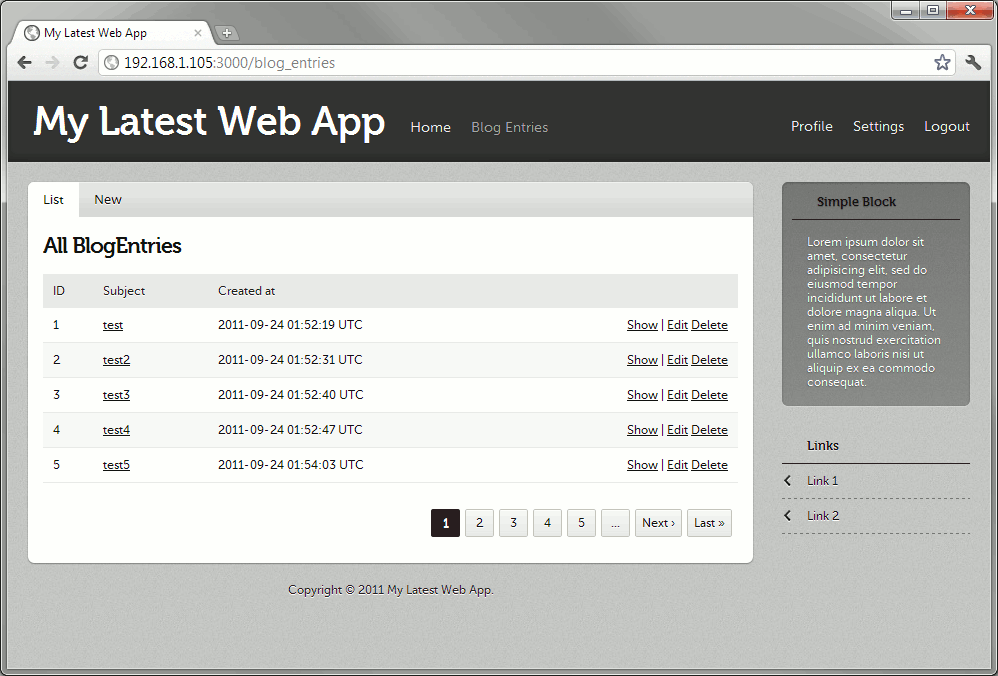
crud screen

Every Rails developer knows how to create a Rails app. It’s easy as

rails new APP-NAME-HERE

But how many know how to create an app from scratch that looks good enough to sell to clients i.e. with slick design, authentication, authorization, and all that? Sure, there are tutorials out there that cover those components, but most of them cover them only in isolation from each other. A quick tutorial containing multiple components at a time would be a valuable resource to anyone planning to start a new app.

As the resident dilettante in these parts, I’ve decided to create such a tutorial based on a recent demo I made for a prospective client.

This post will discuss how to create a Rails 3.1 application that looks good enough to sell to clients (of course, YMMV) while still having components found in “professional” apps. This tutorial will cover the following:

  • Andrea Franz’s web-app-theme gem – this gem generates themes for your web app (hence the name). The demo and the list of available themes can be found on this page.
  • Devise – our authentication module. Authlogic‘s fine, but I find Devise’s approach less obtrusive.
  • Haml – replaces Erb. Not perfect (e.g. screws up with inline a tags) but the drastic decrease in code makes passing it up difficult.
  • Rspec – replaces Test::Unit. Only setup will be covered in this post, actual usage is left to the reader.
  • Kaminari – gem for pagination. We’re going to use it in place of the previous gem will_paginate

Rest of the tutorial is below the cut.

Continue reading “Starting a “professional” Rails 3.1 app with Web App Theme, Devise, and Kaminari”