My Filipino Dishes (with Science!) pt 4: Tinola

In this series of posts, I’ll be discussing the different Filipino dishes that I’ve been cooking and experimenting on for quite some time now.

« You can find out more in the introductory post.

Past dishes:
« Dish #1: Giniling
« Dish #2: Bistek

Just two quick notes for all recipes:

  • Most of them, when paired with rice, will serve 3-5 people.
  • I will only show pictures of the ingredients. I’m leaving the “take a picture of the dish” to the foodies. Go to Google Image Search if you want pictures of the dishes.

I hate Tinola. I hate HATE Tinola. I’ve gone through college and years of work and I’ve never ever ordered Tinola at the turo-turo and cafeteria. I’ve always wondered why people like this dish of tasteless rubber chicken and even more tasteless soup.

Then, just like Giniling, I was asked to cook Tinola for the household.

And so I went around the internet, looking for recipes and stories about cooking Tinola.

And that night I had the best Tinola in my life.

It was then that I figured out the problem with Tinola: Bistek has one subtlety (cooking time) that can make or break the dish; Tinola has a lot more than that. It was easy to see why a lot of Tinola sucked after I learned those subtleties.

Tinolang Manok

(Ginger Chicken Stew)

Tinola

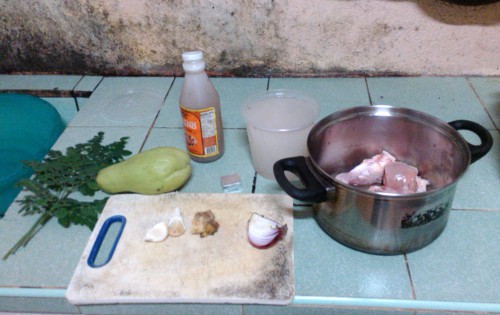
1/2 chicken, quartered (1/4 – 1/3kg)
1 thumb ginger, chopped
1 small onion, minced
2 cloves garlic, minced
1 medium chayote, chopped into blocks
2 branches malunggay leaves
1 chicken bouillon cube
rice water from the first wash
patis (fish sauce)

Step 1: Put the chicken pieces in a pot skin side down and simmer in low heat to render the fat. You can add a bit of water to help the rendering process and prevent the meat from burning.

Step 2: After around 10 minutes, enough fat should have been rendered from the skin to allow stir-frying of the meat. Add a bit of cooking oil if there isn’t.

Add the ginger, onion, garlic, and 1-2 tbsp of patis and stir fry at medium-high heat until the chicken starts to brown.

Step 3: Add the bouillon cube and enough rice water to fully immerse the chicken and enough extra for the vegetables (ie. extra ~1cm margin). Cover and simmer at low heat for 20 minutes.

Step 4: Add the chayote blocks. Cover and simmer at low heat for another 20 minutes, stirring occasionally.

Step 5: Add the malunggay and cook for another 2 minutes (just to blanch the leaves) and serve.

Before I discuss the subtleties, I’d like to point out this one of those recipes where full mise en place is sub-optimal. There is enough time between steps to prepare all of the ingredients:

  1. Peeling and mincing garlic, onion, and ginger can be done while waiting for the fat to render.
  2. Peeling and chopping chayote can be done while the stew is simmering.
  3. Stripping/plucking malunggay leaves from its stalks takes a crapload of time. Start doing it before you add the chayote or you might end up with overcooked chayote by the time you’re done.

Subtlety 1: sangkutsa

You know why you’re getting tasteless “rubber” chickens in your tinola? It’s probably because the recipe you’re using only told you to put all the ingredients in a pot and simmer for 30 mins.

This doesn’t add flavor or even texture to your chicken. Heck, you might be better off microwaving it.

The solution: sangkutsa. The word can mean “marinate”, but here we use its other meaning: stir-frying in rendered fat.

Done right, sangkutsa essentially turns our rubber chickens into skinless fried chickens. The texture is better, and the slightly browned meat has better flavor thanks to our old friend Maillard reaction. Even the browned residue will be useful later: apart from flavor, it also gives the stew its brown tint as the pot is deglazed in the long simmering period.

Subtlety 2: native chicken vs broiler chickens

Another theory why we tend to get tasteless Tinola is because the chickens themselves are tasteless. Tinola predates the modern broiler chicken and it’s safe to assume that most recipes were meant for “native” chickens. Compared to native chickens, broilers have less skin-to-meat ratio and in turn will have less fat and flavor per weight.

There are a couple of ways to get around this:

  • Bouillon cubes – as I mentioned before, chicken stock is rare locally so we’ll have to settle with bouillon cubes or other similar seasonings (e.g. “Magic Sarap”, MSG) to enhance the existing patis/ginger/garlic/stock flavor.
  • Chicken necks – they don’t have a lot of meat so people avoid them, but you’ll get extra skin and the bones give you extra flavor as stock if you use them here.

Subtlety 3: cooking time

Like Bistek, simmering Tinola for a long time improves the quality of the dish. This is normal for most types of chicken soup – long cooking time allows the connective tissue to break down and add flavor to the stock.

Even though Wikipedia notes that chicken soups take 1-3 hours to cook, 45 minutes works well for me. I’m pretty sure it’s because of the pre-cooking in sangkutsa, though if I had to cook native chicken I’ll probably extend the simmering time by 15-30 mins to get more flavor out of the well-used connective tissue.

Subltety 4+: more flavors

Apart from stock and chicken fat itself, there are still other subtleties in the flavor area.

First and foremost is the ginger. It was only when I looked for recipes that I found out that ginger is one of the key ingredients – and yet all of the Tinola I had before never even had a hint of ginger in them.

I’m not saying you should overdo the ginger and make your soup taste like salabat, but you should at least use enough to make the person eating taste and feel some of the heat from the ginger. If you can’t decide how much ginger to use, just remember that Tinola is a cold-weather dish.

Speaking of heat, most recipes call for dahon ng sili (chili leaves) to give more depth to the hot ginger stew and I would suggest beginners to use that instead of harder to prepare malunggay. I prefer the latter mainly because I can get fresh leaves from the virtually unkillable zero-maintenance malunggay trees our backyard.

On to the other vegetable aspect, most recipes also call for unripe papaya instead of chayote. They become the same texture in the end, but I personally don’t like unripe papaya in my tinola. I have a sweet tooth so I prefer chayote’s slightly sweet undertones over papaya’s bitter aftertaste. People who grew up on bitter dishes (e.g. Ilocanos with their Pakbet and Papaitan) usually prefer the former, though.

The last thing I’m going to touch is the rice water. Due to the other factors affecting the taste of the stew, I honestly can’t tell the difference between Tinola made with plain water and one made with rice water. Theoretically the rice starch should thicken the broth but I really don’t have the patience to make 2 batches at the same time and compare both. However, since I’m typically the guy washing and cooking the rice before cooking the ulam, saving the rice washings for Tinola couldn’t hurt.

As a side note, I never thought I’d write a 1000+ word essay on a dish I hated until last year.

(next recipe will be a bonus dish)

My Filipino Recipes (and Science!) pt 3: Bistek

In this series of posts, I’ll be discussing the different Filipino dishes that I’ve been cooking and experimenting on for quite some time now.

« You can find out more in the introductory post.

Past dishes:
« Dish #1: Giniling

Just two quick notes for all recipes:

  • Most of them, when paired with rice, will serve 3-5 people.
  • I will only show pictures of the ingredients. I’m leaving the “take a picture of the dish” to the foodies. Go to Google Image Search if you want pictures of the dishes.

Like Giniling, today’s recipe is so easy that a kid can make it. However, you do need to know “The One Weird Trick™” in cooking it.

Bistek

(Stewed Beef Strips)

Giniling

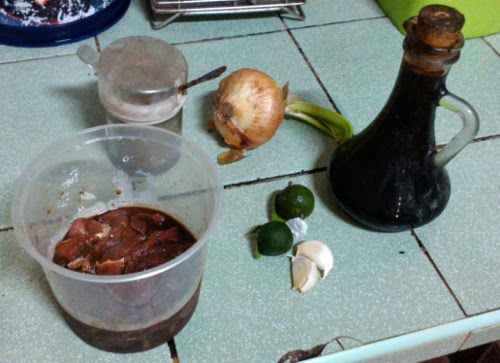
1/4 kg sirloin beef strips
1 medium white onion, cut crosswise (i.e. rings)
2 cloves garlic, chopped
calamansi
soy sauce
1/2 tsp ground pepper

Step 1: In a plastic container, marinate the beef with juice from 2-3 calamansi (use a stainer to remove the seeds), garlic, pepper, and soy sauce (1/4 cup? I just use enough to fully immerse the beef). Let the meat marinate for at least 30 minutes. I like mine marinated for more than 2 hours.

Step 2: Saute onions in oil in a pot. Again I prefer stainless steel.

Step 3: Put the meat (marinade included) in the pot along with around 1/2 cup of water and 2 tbsps soy sauce. Cover and simmer for at least 45 minutes. Stir at 10-15 minute intervals, adding a bit water when it gets too dry. Check done-ness by tearing apart a strip with a pair of forks. The meat should tear with little effort.

Season to taste before serving. We recommend adding more calamansi juice at the end for more bite. Oyster sauce can also be added to the simmering stew for the usual “body and flavor”.

As with Giniling, if you use too much soy sauce, you can try salvaging the dish with sugar.

Just like Giniling, Bistek is another common sight at turo-turo (eateries). It’s also called “Beef Steak” which is both wrong (when compared to the more popular American Steak) and technically right (when taking its Spanish roots) at the same time. Because of this, when you hear a Filipino mention “Pork Steak”, it’s probably not a literal pork steak, but pork chops cooked in the same fashion as Bistek

And by the same fashion, it just means “simmer marinated meat in soy sauce and calamansi juice for a long time”. For people not living in the tropics, you can try to replace calamansi with any other lime-related fruit (not lemon or orange) but I haven’t tried it myself.

The long cooking time is “The One Weird Trick™”: meat goes through the following phases when you cook it:

  1. Soft, tender, and juicy because it’s undercooked (e.g. like a medium rare steak)
  2. Tough and dry because it’s overcooked (e.g. overcooked steak)
  3. Tender and juicy because the collagen has broken down (e.g. stewed/braised/slowcooked meat)
  4. Dry and stringy (overstewed/overbraised meat)

Unfortunately, many people are not aware of the information above and think that their tough, jerky-like Bistek is a problem with prepping the meat e.g. “we should’ve tenderized it with a mallet” or “we should’ve marinated it longer”.

Repeating it again to drill it into your head, if you want tender bistek, you have to simmer the meat for a long time. The 45 minutes is enough since we’re using strips. For thicker cuts, you’ll have to wait for a future recipe that deals with that.

Bonus recipe:

I do this variation if I want to waste time. The only things it does to the final product are (1) make the onions look more presentable i.e. not soggy rings and (2) add a bit more flavor via the Mallard reaction.

We do this by separating the sauteed the onions and frying the meat like Tapa before stewing.

Bistek, the hard way

Same ingredients as above

Step 1: Same as step 1 above, but do not include garlic and pepper as they will burn in the searing process.

Step 2: Saute onions in oil and set aside. To save cleaning, you can do this in the pot that you would use for the next step.

Step 3: Add a bit more oil to the pot and sear the meat (set aside the marinade). You can do this strip by strip or as a whole batch. Since it’s marinated, the meat will give off a lot of liquid and the browning process isn’t as simple as a steak. You can let the juice boil off (just like frying sausages) or you can drain it into the marinade container and add a bit of oil to continue the frying process.

Step 4: Once the strips look like fried Tapa (lol), add the marinade and the rest of the ingredients (sans onions) and continue from step 3 onwards. Upon serving, top the dish with the sauteed onion rings.

Next recipe: Tinola »

My Filipino Dishes (with Science!) pt 2: Giniling

In this series of posts, I’ll be discussing the different Filipino dishes that I’ve been cooking and experimenting on for quite some time now.

« You can find out more in the introductory post.

Just two quick notes for all recipes:

  • Most of them, when paired with rice, will serve 3-5 people.
  • I will only show pictures of the ingredients. I’m leaving the “take a picture of the dish” to the foodies. Go to Google Image Search if you want pictures of the dishes.

For this first recipe, I present the very first dish I learned to cook on my own:

Giniling

(Ground Meat Soup… ok, that translation sounds weird. It’s like saying Chili is “Ground Meat Chili Soup”)

Giniling

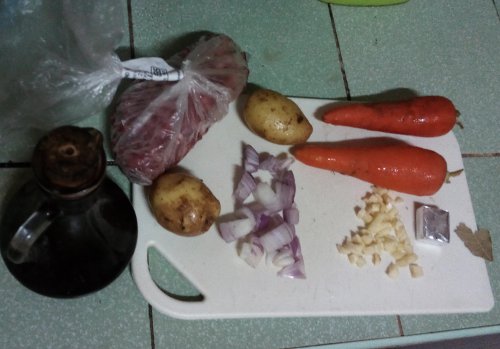
in the picture: small carrots and potatoes in place of medium

1/4 kg ground beef
1 medium carrot, diced
1 medium potato, diced
1 small onion, minced
2 cloves garlic, minced
1 beef bouillon cube
1 small bay leaf
2 tbsp soy sauce

Step 1: Put the beef in a pot (I prefer stainless steel) over medium-high heat. Stir the meat around once in a while to evenly brown it. As the beef starts to brown, dump in the onion and garlic and saute them along with the beef.

Step 2: When the beef has finished browning, add the rest of the ingredients. Add water until the vegetables are fully immersed. Cover the pot and let it simmer (stirring occasionally) until the vegetables are cooked. Season to taste and serve.

Giniling (literally: ground- e.g. “giniling na baka” is “ground beef”) is a dish made with ground meat as the base. It has many variations, the most common of which resembles Picadillo – ground beef with minced/diced vegetables and tomato sauce. The dish can easily be tweaked to make the other versions and we will go through them later.

As mentioned above, this soupy, soy sauce-only variation is also the first Filipino dish that I learned to cook without any guidance as a grade school student, a testament to how easy this dish can be made. It’s also almost the same recipe, with slight modifications based on the lessons that I learned since the first time I made it.

Now on to the “Science”, starting with the meat.

Anyone who has made burgers will know the importance of the lean/fat ratio – lean cuts like ground sirloin (90/10) will reduce the fat at the price of flavor. Using cheap ground beef (70/30), however, tends to make the dish drown in fat. I would suggest using ground sirloin first then experimenting with mixing it with the cheap stuff.

Don’t wash the ground beef on a strainer! You might find this weird but some people actually do this. Some say it’s to clean the meat (no need, bacteria will die at browning), others say it’s to reduce the fat (just get a leaner cut or scoop out some of it after browning). The only good reason for washing beef is to find bits of bone in the meat, and this can easily be remedied by buying your beef at any decent meat store.

In terms of cooking, it’s ok to just cook the beef to gray done-ness especially if you’re pressed for time, but browning (i.e. Mallard reaction) imparts additional flavors to the meat.

(For the newbies: by “brown”, we don’t actually want you to overcook it to “totally brown”. It’s more like “gray with brown bits” like your favorite fast food burger. Browned meat bits covering a good portion of the bottom of the pot is a good sign to stop.)

With the meat done, step 2 is all about turning the dish from “Stir Fried Ground Beef” to “Giniling“. Let’s run through the rest of the ingredients and the possible variations:

The “add-ons” provide a contrast for the flavor and mouthfeel and should be small or at least bite-sized. Traditionally this would mean diced carrots, potatoes, and chayote (I love chayote, but I usually reserve it for other recipes so it’s not in this one). Variations include raisins, peas, corn (all 3 require no prep, and peas, corn, and carrots are the basic frozen mixed vegetables), and boiled quail and chicken eggs.

String beans as the lone addition is another option. This will turn the recipe into a cross between Giniling and Adobong Sitaw so no tomato sauce should be added. You can saute the green beans for a while before adding the water, or you can just let it boil/steam.

The remaining ingredients build the flavor profile. Soy sauce and/or tomato sauce/paste provide the base flavor (oddly enough, these two ingredients work well together). We don’t use tomato sauce in our household for practical reasons: while soy sauce is used everywhere, tomato sauce isn’t and will just sit idle in the ref. Not to mention that there’s no much difference in the flavor whether you use it or not (IMO).

The bay leaf is there for the aroma; don’t use too much of it or it will overpower the basic flavor. You can remove the bay leaf before serving if you want.

Beef bouillon cube isn’t a traditional ingredient, but I find bouillon cubes to be a better alternative than guessing the right amount of salt to bring out the body and flavor of many Filipino dishes. (Beef stock would be nice, but since when did you see beef stock in your average Filipino household?) Sometimes I also add oyster sauce for extra body and a hint of sweetness.

And finally, the last ingredient: water. Adding enough water to cover the vegetables will produce soupy Giniling. In some cases, you may not want a soupy dish e.g. you’re serving it along with stew. You can reduce the amount of water by half in those situations.

You shouldn’t remove water and rely solely on the soy sauce for liquid, however, as you need water to cook the vegetables and help >deglaze the bottom of the pot where much of the flavor is still stuck.

And that’s it, a basic Filipino dish that a child can cook. You can’t really go wrong with it apart from adding too much soy sauce and making it too salty, and even then you can try to salvage it by adding sugar.

Next dish: Bistek »

My Filipino Dishes (with Science!) pt 1: Introduction

If I were to be asked about my specialty as a hobbyist cook, I’d say it’s Italian. Most of the food pics I’ve taken in the past years are either experiments in spaghetti or homemade pizza.

Through some unforeseen events, however, I had to brush up on Filipino cuisine earlier this year as I took on the role of designated dinner cook for our household 4-5 times a week. My productivity took a nosedive (I had to budget 1-2 hours a day out of my work) but it gave me a chance to experiment and level up my Filipino cuisine cooking skills.

In these series of blog posts, I’ll be discussing the various dishes that I have been making on a regular basis. To make this different from other cooking blogs, I won’t just be posting a recipe handed down to me by my mother/grandmother. Instead, I’ll try to look a bit deeper into the recipes and attempt to explain why some cooking techniques work and why some don’t. In short, I’ll be doing a mini Good Eats / Serious Eats Food Lab for every dish.

But before that, let’s get one thing out of the way first…

The obligatory “Why hasn’t Filipino cuisine caught on abroad yet?” discussion

I’ve had some small discussions with friends about cooking recently and this topic came up a couple of times. Since I’m writing blog posts on Filipino cuisine, I might as well give my 2 cents on the subject now.

In my opinion, there are a few big reasons:

1. Filipino cuisine is rustic and practical.

For reference, look at Japanese cuisine. The “boom” in Japanese cuisine was through sushi – an exotic dish whose preparation takes years of experience to master. But do Japanese people eat sushi everyday? Not really. Their regular dishes are not that different from their East Asian and Southeast Asian neighbors.

I feel that many are trying to do the same thing with Filipino cuisine, find a class of Filipino dishes that will get a restaurant a Michelin star. But that won’t happen – while there are certainly a lot of exotic Filipino dishes, AFAIK none of them have the same level of sophistication as, say, French cuisine. You can certainly dress them up as such, but people will see through the farce.

On a similar note, the “practical” above also means that Filipino cuisine are often full of fat – something that you’d want to have to prepare for famine (especially in a country frequently devastated by Typhoons). Until the whole “fat is evil” propaganda is corrected to “excess food is evil” in the biggest accessible potential market for Filipino cuisine (USA), it will definitely be a hard sell.

2. Filipino cuisine is (and isn’t) fusion cuisine.

Being a colony and trade port for so long, Filipino food has been influenced a lot by other cultures, whether it’s the pre-colonial regional influences (Chinese, Malay/Indonesian) or the more recent influences (Spanish, American). Because of this, it’s hard to claim a dish is purely “Filipino” or not.

What some don’t realize is that it’s okay for a “Filipino” dish to not be “purely” Filipino. There are many dishes that we attribute to a certain culture that are actually heavily influenced by foreign cultures e.g. tonkatsu. All that matters is that we’ve adapted that dish into our lives, modifying it such that it is more practical given the availability of ingredients and such that it’s flavor fits in with what the mainstream considers “tasty”.

This also means that we probably shouldn’t market Filipino cuisine as “fusion cuisine” because we already adopted them as “Filipino” (with a few exceptions like, say, banana ketchup spaghetti). Just as forcing ourselves to find a “truly Filipino” dish is blindly nationalistic, going the opposite route may be perceived as belittling one’s own nation’s culture.

3. Pansit, Lumpia, and Adobo.

Screw Pansit, screw Lumpia, and screw Adobo. I’m ok with them, but they’re definitely not on my list of favorite Pinoy foods. I’m not even going to write about them in this series except for one of them, and that’s only because they’re so close to another dish.

But when you ask a 2nd or 3rd generation Filipino-American about their favorite food, it’s always these three freaking dishes that their Lola used to make. No mention of the various stews, grilled foods, deserts, etc. No mention of the regional dishes and how they contrast with the ones found in Metro Manila.

In other words, so many of these people are out of touch with what’s really being eaten in the “motherland” and we cannot expect them to promote Filipino cuisine well.

With that out of the way, let’s move on to the first dish »

Vocal Retraining

..or podcast, whatever you want to call it.

So I’m gonna be recording rants for the next few weeks to figure out and fix my vocal problems. I’m ok with topic suggestions but I’m not really expecting any.

Will be posting the recordings on this site until I get to setup another page for the recordings (probably a wiki).

Episode 0 – Intro

Episode 1 – Pizza (pt1 of 2)

Episode 2 – Pizza (pt2 of 2)

UPDATE

Podcasts now posted daily at http://bry-rants.tumblr.com/