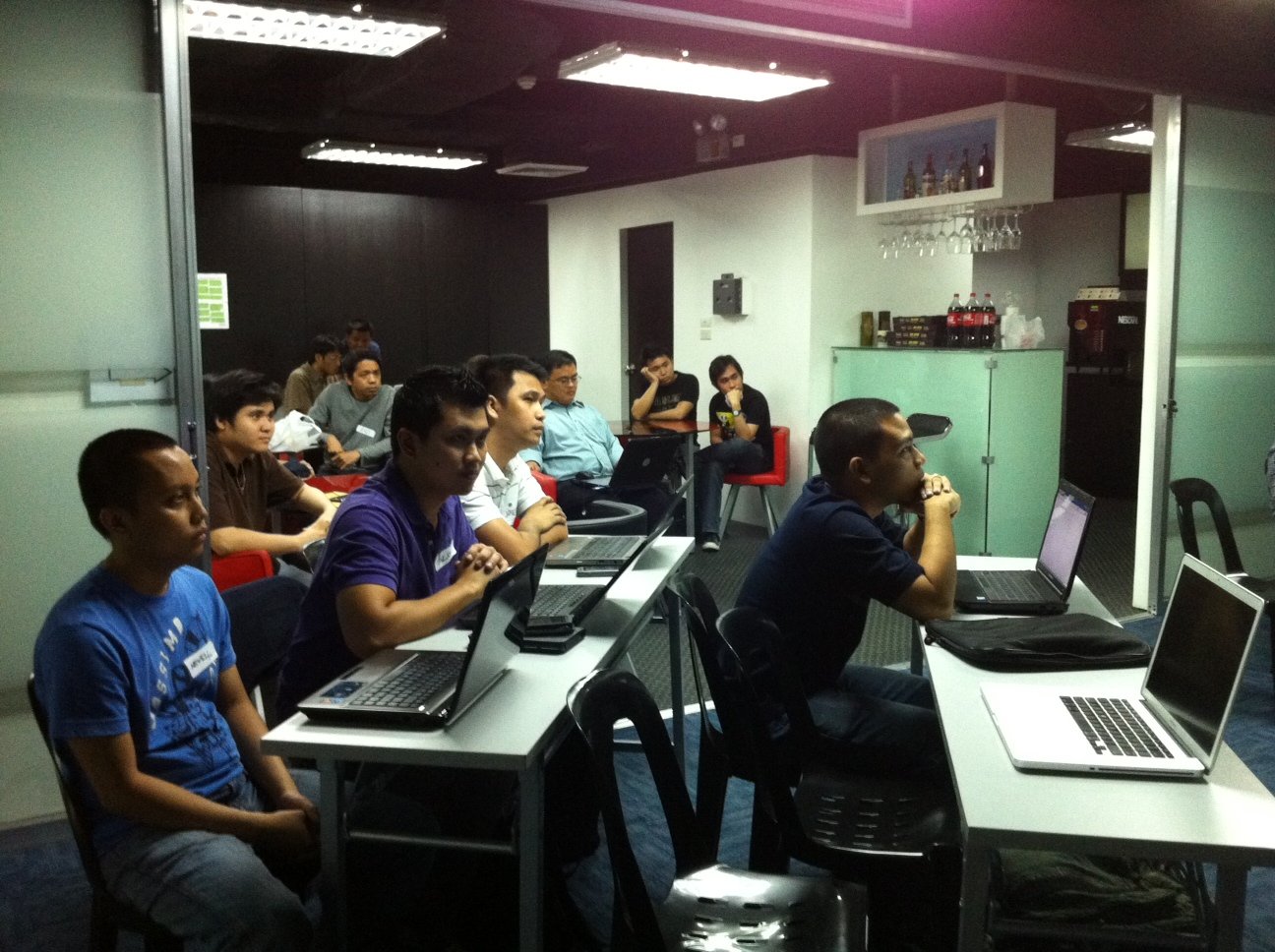
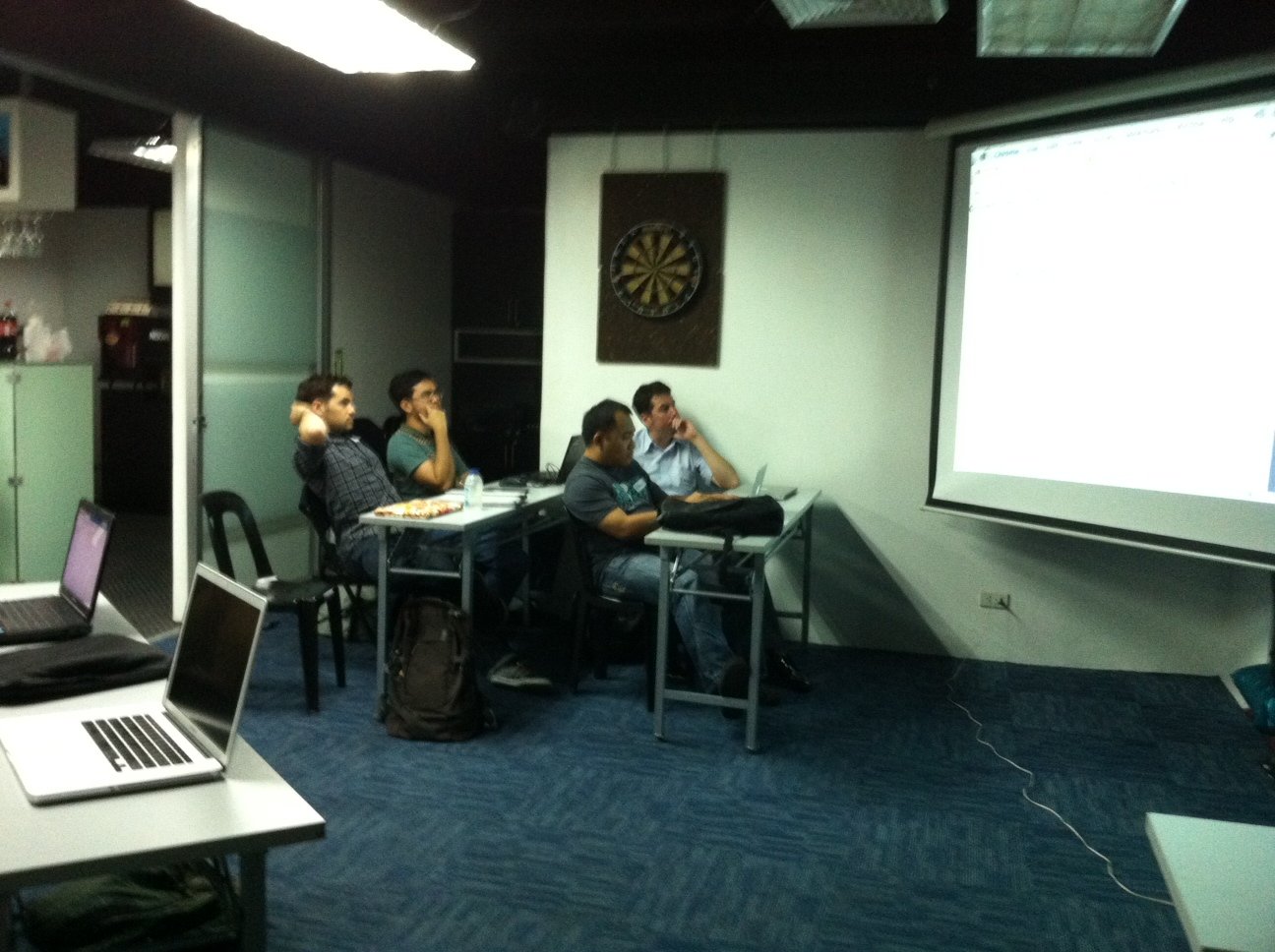
Last Friday, I got to teach about collections and closures in Ruby for ECC. That gave me an idea to write a post about one of the mistakes people coming from other languages tend to make when going into Ruby.
Let’s take the first problem from Project Euler:
If we list all the natural numbers below 10 that are multiples of 3 or 5, we get 3, 5, 6 and 9. The sum of these multiples is 23.
Find the sum of all the multiples of 3 or 5 below 1000.
Looks simple enough. In pseudocode, your typical fresh grad programmer might do this:
sum <- 0
for i <- 1 to 999
  if i % 3 == 0 or i % 5 == 0
    sum += i
  end if
end for
A rubyist, however, will compress that 6 line program into a single line. Here is one possible solution:
(1..999).select { |x| x % 3 == 0 or x % 5 == 0 }.reduce(:+)
This line of code chains the 3 main components of the algorithm above:
(1..999) - find a way to process numbers from 1 to 999. Here we created a Range that we can process as a whole..select { |x| x % 3 == 0 or x % 5 == 0 } - process only the multiples of 3 and 5. Here, the method called selects only the elements that return true inside the passed block..reduce(:+) - find the sum of the elements. Here we used the shorthand form of Ruby's reduce operation that sums the elements.
Let's try a harder example, problem 6:
(1..100).reduce(:+) ** 2 - (1..100).map { |x| x * x }.reduce(:+)
Here we see Ruby's map, which simply creates a copy of the source collection and applying the mapping function to each element. The map above is pretty trivial; we could even replace it with the long form of the reduce method.
(1..100).reduce(:+) ** 2 - (1..100).reduce(0) { |sum, x| sum + x * x }
While method chaining wouldn't be new to the novice developer, the concept of passing functions to methods, allowing greater flexibility, will be. Functional programming has been long forgotten even at the top universities in this country.
Another problem is that method chains can be too long. Some people call these chains "train wrecks". Obviously, this is a subjective matter, but one cannot deny that very long method chains are hard to debug. For example, here's one possible solution to problem 20:
(2..100).reduce(:*).to_s.scan(/./).map { |x| x.to_i }.reduce(:+)
This line simply:
- creates a range from 2 to 100 (1 is ignored in the factorial)
- calculate the factorial by multiplying them together
- convert it to a string
- create an array whose elements consist of single characters from the string (
split("") also works)
- convert each element to integer
- calculates the sum of the elements
One way of debugging this long method chain would be to insert a tap method call to inspect the intermediate value of the chain. For example, if you do this:
(2..100).reduce(:*).to_s.scan(/./).map { |x| x.to_i }
.tap { |x| puts x.inspect }.reduce(:+)
you'll get the array of numbers before the reduce.
irb(main):001:0>(2..100).reduce(:*).to_s.scan(/./).map { |x| x.to_i }
.tap { |x| puts x.inspect }.reduce(:+)
[9, 3, 3, 2, 6, 2, 1, 5, 4, 4, 3, 9, 4, 4, 1, 5, 2, 6, 8, 1, 6, 9, 9, 2, 3, 8, 8
, 5, 6, 2, 6, 6, 7, 0, 0, 4, 9, 0, 7, 1, 5, 9, 6, 8, 2, 6, 4, 3, 8, 1, 6, 2, 1,
4, 6, 8, 5, 9, 2, 9, 6, 3, 8, 9, 5, 2, 1, 7, 5, 9, 9, 9, 9, 3, 2, 2, 9, 9, 1, 5,
 6, 0, 8, 9, 4, 1, 4, 6, 3, 9, 7, 6, 1, 5, 6, 5, 1, 8, 2, 8, 6, 2, 5, 3, 6, 9, 7
, 9, 2, 0, 8, 2, 7, 2, 2, 3, 7, 5, 8, 2, 5, 1, 1, 8, 5, 2, 1, 0, 9, 1, 6, 8, 6,
4, 0, 0, 0, 0, 0, 0, 0, 0, 0, 0, 0, 0, 0, 0, 0, 0, 0, 0, 0, 0, 0, 0, 0, 0]
=> 648
Not exactly pretty, nor is it the most interesting use of tap, but it still gets the work done.
As a bonus, I'd just like to share a realization I had a while back.
Web developers shouldn't have to have problems with list processing because they deal with lists all the time: in SQL!
Think about it, you can define filter options in WHERE clauses, while map and reduce can be done in the SELECT clause. Assuming you have a table numbers with a column number with 100 records, each corresponding to numbers from 1 to 100, problem 6 can be solved by the following SQL statement:
SELECT SUM(number) * SUM(number) - SUM(number * number) FROM numbers