Very busy week ahead. Here I am coding at 2AM in the morning instead of playing StarCraft or something.
Might as well make a quick post before continuing with work.
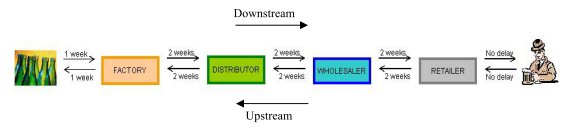
I first heard of the Beer Game in a presentation over at InfoQ. While not involving actual beer (boo!), the simple game provides an interesting glimpse at a certain management dilemma.
This game is played by teams of 4 players, each representing a part of a beer distribution supply chain: Factory, Distributor, Wholesaler, Retailer. The object of the game is to minimize the expenses involved in handing orders, namely the costs for stocking and the expenses caused by unfulfilled back orders.
The “kicker” here is that communication between the players are limited, some variations only allow players to order from each other and nothing else, while some variations of the game only allow the players to see the inventory of the next player in the supply chain.
The common result of this is the bullwhip effect: an oscillating period of over and under-stocking. For example:
- Retailer receives an order for 10 cases of beer. To anticipate for future orders, he orders 20 cases of beer from the Wholesaler.
- Having received an order for 20 cases of beer, the Wholesaler orders 40 cases of beer.
- With the same logic, the Distributor orders 80 cases.
- Finally, the Factory produces 160 cases.
Even ignoring the expiration of the product, one can easily see the waste produced by this scheme. There’s the warehouse stocking expenses. There’s also the expense in hiring employees to meet the sudden increase in demand, as well the expense in firing employees and shutting down equipment because of lack of demand.
And so we see the importance of visibility and transparency within a supply chain. When the suppliers upstream have the same information as the Retailer, it’s easier for them to decide how much to actually produce to reduce waste.
Note that this doesn’t just apply to manufacturing. Any situation with a work pipeline (e.g. software development’s Analyst-Developer-QA-Ops) benefits from increased visibility of resource utilization and work load.

