Agruing

Given that man is a social animal, he will encounter ideas in conflict with his own. For example, one guy might like Pepsi while another person might perfer Coke. There are a couple of ways how the clash of ideas between the two will turn out:

Given that man is a social animal, he will encounter ideas in conflict with his own. For example, one guy might like Pepsi while another person might perfer Coke. There are a couple of ways how the clash of ideas between the two will turn out:

  1. One side will concede that the other side is more appealing and will change sides. – It’s rare but it does happen sometimes.
  2. Both sides will concede that some of the points the opposite side are valid, but they will not change sides. In other words, they’ll agree to disagree – This is a more likely outcome than the first.
  3. They will come to a compromise. – This usually happens when a third option is viable. For example, if a guy in a group wants steak for dinner while another guy in the group wants pizza, the argument can be resolved by going to a restaurant that serves both steak and pizza.

Now what I just wrote above is what happens when civilized people are arguing. When dealing with pricks in the Internet (or pricks in general), there is another possible outcome:

  1. FUCK YOU AND YOUR LOGIC!!!!!

This is, of course, the main reason why people say arguing in the Internet is stupid.

The traditional approach to such trolls is to just ignore them. That would work in normal situations, but if you’re faced with a closed-minded individual threatening to affect your life e.g you’re sure that you’ll go through a world of pain if the group goes with his ideas, you will have to get creative.

Personally, I always use one certain approach when logic fails to convince the troll:

Memetics, baby!

By treating arguments as memes, one will realize that instead of trying to attack your opponent’s meme directly with your own, it makes more sense to make your meme more appealing to the other members of the society so that they would accept it. The point here is that you do not need to convince your opponent that he is wrong — the mere fact that everybody believes he is wrong makes things moot.

One thing to note about this approach is that numbers mean nothing when memes collide. Your opponent may have convinced a thousand people that he is right, but unless those people are really influential with regards to the issue you can still “win” even if you have just 5 directly influential people indoctrinated with your meme.

Another thing to note is that the meme approach isn’t as simple and easy as it looks, and it can backfire especially if you’re not really familiar with your target audience. If you’re not confident about using this approach, I would suggest that you try to find other alternatives instead.

On Software Engineering

One of the most important concepts one must understand when entering the IT industry is the fact that Computer Science is different from Software Engineering.

One of the most important concepts one must understand when entering the IT industry is the fact that Computer Science is different from Software Engineering.

I hold a degree in Computer Science, and like most fresh graduates, once I stepped into the corporate world, I immediately found out that what I have been studying for 4 years has almost nothing to do with real-world software development. For example, the theories in computing that we have studied in college are rarely applicable in real-world applications. Even the approach to programming itself that was taught to us in college was fundamentally flawed – we were never taught how to program in groups, or to program with maintenance in mind.

College teaches us to build dog houses. The real world wants us to build skyscrapers.

So here we arrive at the problem: the misconception that Computer Science knowledge is enough to develop good software. And here’s where Software Engineering steps in.

Without going to much into the technical details, we can look at “engineering” as simply the application of science to practically solve problems. Civil Engineers use Physics to create structurally sound buildings (i.e. structures that won’t collapse and kill people). Electronic Engineers also use Physics to build consumer electronics (i.e. devices that don’t blow up and kill people). Chemical Engineers use Chemistry to process chemicals into more useful ones (i.e in plants that don’t blow… you know the drill).

Steve McConnell (my favorite author in the industry), in his book Professional Software Development, uses Physicists to show why making scientists do engineering stuff is a bad idea. In the book, he asks you to imagine what would happen if a person with a PhD in Physics would be asked to “design electrical equipment for commercial sale”.

While the physicist would probably be able to design a working prototype of the device, it is not likely that he will take into account the factors that come in when designing commercial products.

  • Will the device be robust enough to withstand day to day use?
  • Will it pass safety standards?
  • Is the cost of materials and production low enough to produce profit?

As you can see, the problem here is almost the same as the problems I encountered above when I started building real-world applications.

By now the importance of Software Engineering knowledge should be clear to you. If you’re a software developer, it is your responsibility to study the various aspects of SE to improve the quality of your work.

If you’re a manager, not only is it your responsibility to be familiar with the organizational and processes side of SE, it is also your responsibility to train new employees in SE. I would even have to go as to say that you must make them unlearn (brainwash?) some of the “unhealthy” practices that they have learned in college.

As SE (along with Project Management) is my primary focus nowadays, expect to see me post more SE stuff here in the future.

First Post

Yay, may sariling website na rin ako!

Seriously, though, being unemployed does have its benefits. For one, I’ve got a lot more time on my hands — I wouldn’t have the time to manage a personal website if I hadn’t left the company.

For this first post, I’ll give away one of my main mantras in life. It’s from the ancient military text Sun Tzu’s Art of War.

Yay, may sariling website na rin ako!

Seriously, though, being unemployed does have its benefits. For one, I’ve got a lot more time on my hands — I wouldn’t have the time to manage a personal website if I hadn’t left the company.

For this first post, I’ll give away one of my main mantras in life. It’s from the ancient military text Sun Tzu’s Art of War:

IV. TACTICAL DISPOSITIONS

8. To see victory only when it is within the ken of the common herd is not the acme of excellence.

9. Neither is it the acme of excellence if you fight and conquer and the whole Empire says, “Well done!”

10. To lift an autumn hair is no sign of great strength;
to see the sun and moon is no sign of sharp sight;
to hear the noise of thunder is no sign of a quick ear.

11. What the ancients called a clever fighter is one who not only wins, but excels in winning with ease.

12. Hence his victories bring him neither reputation for wisdom nor credit for courage.

13. He wins his battles by making no mistakes.
Making no mistakes is what establishes the certainty of victory,
for it means conquering an enemy that is already defeated.

14. Hence the skillful fighter puts himself into a position which makes defeat impossible, and does not miss the moment for defeating the enemy.

15. Thus it is that in war the victorious strategist only seeks battle after the victory has been won, whereas he who is destined to defeat first fights and afterwards looks for victory.

16. The consummate leader cultivates the moral law, and strictly adheres to method and discipline; thus it is in his power to control success.

People who’ve seen the 2004 Engineering yearbook might be familiar with it because this was my write-up. Instead of wasting my time describing myself or what I’ve done in my four years of college, I just chose the text that best described my modus operadi then, namely, constantly putting myself in positions where I can’t lose. This was how I was able to graduate without a hitch even though I spent my nights playing CS and Ragnarok instead of studying, avoided joining UP Cursor (i.e. I don’t have that much connections), and became a full time officer of UP AME.

It was my mantra then, and it’s still my mantra up to this day. My stint as a corporate drone in Azeus up to my sudden departure still fits the theme of the text above. True, there were (a lot of) times where I was pushed beyond my limits, but even in those cases, I never considered myself truly “lost” when looking at the big picture.

Now here I am, unemployed due to a conflict of ideals.

And I still haven’t lost yet. ^_^

Fitness post 3 – Diet Basics

(migrated from an old blog)

More basic concepts in this post. This time it’s about dieting.

Before everything else, I’d like to make it clear that when I mention “calorie” below, I am referring to kilogram calories i.e. the one shown in the nutritional information labels at the back of food packages.

You don’t need to count your calories, but doing so will really help.

Counting calories is like meticulously noting every expense you make everyday to manage your finances. I think the latter is overkill; I personally just make sure I don’t spend too much on non-essential stuff.

Similarly, you can get away with some rules of thumb, like “Eat in moderation” or “Avoid food with a lot of refined sugar”. Combined with regular exercise, you will probably get results in a couple of weeks.

What calorie counting has over these simple rules of thumb is that you could see where you are failing in controlling your calorie intake. One common mistake is drinking a lot of juice or iced tea throughout the day: if you don’t count calories, you might not realize that four servings of those are equivalent to a single meal (480 calories). By determining these simple pitfalls, you could easily change your diet accordingly.

It’s going to be technical from here on. :P

One pound of fat is equal to 3,500 calories.

This is the simplest equation relating food intake to weight loss. Simply put, if you want to lose one pound, you’ll need to have a calorie deficit of 3,500 calories. Likewise, if you want to gain one pound, you’ll need to eat 3,500 more calories than you use.

Estimating the amount of calories you burn everyday will help you determine how much you can eat and how much you need to exercise to lose weight.

In order to do this, you can calculate your Basal Metabolic Rate (BMR) using this link, then follow up by using the Harris Benedict Equation here.

As those sites will tell you, consuming less than the calculated value will cause weight loss and vice versa.

e.g. If the result is 2,000, by consuming only 1,500 calories per day, you can expect to lose one pound a week (7 * -500 = -3,500).

A weight loss rate greater than 2 pounds per week is dangerous for most people. Anything greater than 2 pounds will most likely result in greater weight gain in the future

or in simpler terms:

Never starve yourself.

If you’re planning to lose 10 pounds in a month, forget it.

The problem with the calorie counting approach is that most people don’t know how the body works when it comes to calories. Having a naive approach on weight loss, one might consider getting a deficit of over 1,000 calories per day. For sedentary individuals, that’s basically fasting – just 1 full meal a day.

Unfortunately, after hundreds of thousands of years of wilderness survival, the human body has evolved to react to famine. Once the brain has noticed the sharp decrease in food intake, it will tell the body to go into starvation mode. This will result in two things: First, the body’s metabolic rate will go down in order to save energy; and second, the body will focus on storing energy in the fat tissues until the “famine” is over. Pretty much a nightmare scenario for a person who wants to lose weight, huh?

To avoid this, people new to dieting should take things slow at first. Cutting 200 calories won’t be noticeable, but it could still make you lose a pound in just two and a half weeks. I would suggest that you first reduce the amount of high calorie foods that don’t fill you up (e.g. candies, ice cream).

Space your food intake such that you don’t feel famished. Never skip a meal.

These pieces of advice make you avoid going into starvation mode.

A good spacing for food intake is 3 hours. For average people, that would be “breakfast – snack – lunch – snack – dinner (- midnight snack)”. A four hour spacing is ok, but I doubt you could last for 5 hours without eating without causing your body to lower your metabolic rate.

Fad diets might work, but don’t count on it. A balanced diet is still the way to go.

There are three major components/types of food: carbohydrates that provide energy, proteins that help build up the body, and fats that provide additional nutrition and energy. A balanced diet means eating a decent amount (not a lot) of carbohydrates, some protein, and a little fat.

Fad diets focus on removing one of those three components, or changing the allocation to a different ratio, or adding some other weird component into the mix. There are problems with these approaches, though.

Removing one component is dangerous. Removing carbohydrates would force you to take in more fat than what is advisable. Removing fat deprives you of the nutrients that are only available in fat (EFA, fat soluble vitamins). Removing protein… well… that’s too crazy if you ask me. Changing the ratio from high carb : medium protein : low fat is just as dangerous.

Adding some weird component should always be taken with a grain of salt. As of this writing, there is no extensive scientific evidence that a single food or drug that can safely and significantly reduce weight on its own. For example, food that increase metabolism (e.g. caffeine, other stimulants) often only increase the calorie usage by around 100-200 calories, and Orlistat (Xenical) has a lot of side effects.

In short, just stick to the normal ratio of carb/protein/fat. Body fat is a result of excess calories so it doesn’t matter what type of it comes from. Reducing the overall calorie intake will be enough for the diet part of controlling your weight.

Forget glycemic index. Just make sure you include protein or fat in your snack so that you’ll feel sated longer.

Ever experienced being hungry in the afternoon and you decide to eat something full of sugar like some scoops of ice cream or maybe some chocolate chips? If you recall that day clearly, you would probably remember craving for food just an hour or two afterwards.

What happened here was an insulin spike. You ate something full of refined sugar and this quickly raised your blood glucose level. Your body noticed this so it released a lot of insulin to control the glucose level. Because of this, your blood glucose level plummeted. Then your body reacts to the very low blood glucose level by telling you that you are famished and you need to eat NAO!!!

This is a very common scenario. When people tell you this, they often follow it up with explaining the “glycemic index” of foods: food with high GI (mostly simple carbohydrates) quickly increase your blood glucose level, while food with low GI release the energy slowly and in turn avoids the insulin spike.

Ok, so I did just that. :P

Anyway, those people usually stop right after telling you to avoid eating food with high GI and vice versa. Unfortunately (or fortunately), that’s not the whole story. There is a way to avoid insulin spikes when eating high GI food: include low GI food in the mix. This could be in the form of protein or in the form of fat. Not only does this promote balanced diet, this also, as mentioned in the header above, makes you feel sated longer.

Regardless of whether you are counting calories or not, you must be familiar with how many calories are contained in the food you eat everyday.

I’ve already mentioned one value above: a serving of juice or iced tea is 120 calories. Now take into account that a cup of rice is 250 calories. While the latter is still relatively high in calorie content, it is more filling (in the sense that you probably won’t eat rice as often as you could drink juice) and healthier. Deciding on which food to eat will be slightly easier if you knowing their relative calorie content.

Beyond calories, I suggest that you should also be familiar with the protein, fat, and fiber content of food. Fiber is often overlooked by people nowadays, which is sad considering its health benefits and the diseases related to lack of dietary fiber.
Fitness post 2 – Basics

(migrated from an old blog)

It may not be apparent at first, but anyone who wishes to go on a fitness regimen must be ready to do a lot of research on various topics. While not as important as determining your reason for dieting and exercising, having the necessary knowledge will help you avoid the disappointments caused by the lack of results from your efforts.

I’ll try to be as direct as possible in my posts to the point that some concepts will have to be dumbed down. I’ll leave it to you guys to do the extra research on the topics if you have the time.

This post will cover some of the basic concepts that people have to know when going on a fitness regimen. For your convenience, I’ve summarized them to short rules of thumb.

You want to lose fat, not weight.

Let’s put it this way: you could chop off your arm to lose weight quickly, but you probably wouldn’t do that, right?

This is probably the most important concept that everyone taking a weight loss regimen must know. This concept alone throws away a good number of misconceptions about dieting and exercise. Most of those so-called “advice” do not take into account that you don’t want to lose muscle along with fat.

Related to this concept is the concept of Body Fat Percentage which specifies how much of your body is made of fat. You might have heard about Body Mass Index which compares your weight with your height that’s not really an accurate measurement of fitness. Here’s a page showing just how BMI compares to BF% (here’s a similar page for the ladies). The only reason BMI is getting more attention than BF% is because it’s a much easier to measure the former than the latter, all you need is a weighing scale and something to measure the person’s height. For BF%, you’ll be needing specialized tools that are either expensive or hard to find, and neither can guarantee accurate results.

At this point it should be clear to you that managing your fat level is much more important than losing weight.

Dieting makes you lose both fat and muscle.
Aerobic exercise makes you lose fat and a bit of muscle.
Anaerobic exercise makes you lose a bit of fat. At the same time, it makes you gain muscle.

I had to oversimplify things, but this oversimplification should be enough for people new to the fitness scene.

Dieting makes you lose both fat and muscle. – Your body uses up energy to maintain bodily functions and perform tasks (no shit, Sherlock). Normally, that energy comes from food. Eat more food than what your body uses and your body stores the excess as fat. Eat less food than what your body uses and your body looks for other sources of energy, namely, your muscles and fat cells.

What many people fail to understand is that you cannot ask your body to just burn fat for energy. Under normal circumstances, your body will burn both muscle and fat for energy. Because of this, dieting alone will not lower your BF%. Even if you do follow a dieting regimen religiously, the most you can get from dieting is to turn into a skinny person like Nicole Richie in the link above.

Aerobic exercise makes you lose fat and a bit of muscle. – For those of you who recall their high school biology, aerobic respiration is the conversion of sugars to energy with oxygen in the equation. This produces more energy than anaerobic respiration (the one without oxygen), and as such, aerobic exercises are characterized as exercises that can be performed continuously for relatively long periods. Jogging and cycling are examples of aerobic exercises.

Aerobic exercise can be thought of as similar to dieting. It burns through your energy stores then when it’s depleted (especially after “hitting the wall”, roughly around the 30km mark of jogging), it focuses more on to your muscle and fat. The main reason why aerobic exercise appears to burn fat is that it helps deplete your excess energy (which could have been stored as fat). The muscle loss is also not drastic because most people don’t hit the wall when they perform exercises, and the body also repairs some of the muscles damaged due to the exercise (ala anaerobic).

Anaerobic exercise makes you lose a bit of fat. At the same time, it makes you gain muscle. – Now we move on the anaerobic exercises. Unless you’ve been reading articles related to fitness in the recent years, you might have the impression that anaerobic exercises (esp. weight training) should only be done by athletes and body builders. I can’t blame you: it’s hard, it’s painful, and to top it off, most people do it wrong.

Same as aerobic exercises, anaerobic exercises also help deplete your excess energy stores. Unfortunately, it takes a lot more effort to burn the same amount of energy with anaerobic exercises than with aerobic exercises. Anaerobic exercises, however, put more strain on the muscles, forcing the body to repair and reinforce the muscles. This would lead to increased muscle mass.

In case you haven’t noticed yet from the two articles on BF% above, having muscle in place of fat is a lot better than having none at all. Muscle is denser than fat, and so having more muscle actually makes you look thinner than someone with the same weight and height. Having more muscle allows you to burn more energy every day, making controlling your calories easier.

By now you might have noticed that I am a bit biased against aerobic exercise. Well, that’s true:

Aerobic exercise is out, Anaerobic exercise is in.

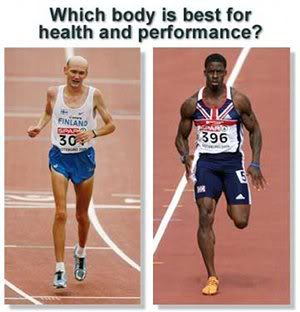
Don’t believe me? This picture from the intarwebs might convince you:

On the left is an Olympic marathon runner, while on the right is an Olympic sprinter. Yes, the pics are deceiving, but the trend is there – marathon runners are lean, but not muscular. After hundreds or thousands of hours of running, their bodies are trained to be efficient when it comes to energy because they need their energy stores to last 42 km.

On the other hand, sprinters are more muscular. They’re trained to be energy inefficient, burning through their energy stores in 400m or less.

By the time people noticed that energy inefficiency was better than energy efficiency when it comes to losing weight, it was already too late — people are already conditioned to think that aerobic exercise burns fat better than anaerobic exercise (in the short term, yes; in the long run, no). Still, there are a growing number of fitness experts that favor anaerobic exercises for weight loss and this has resulted in more recent anaerobic exercise focused techniques like HIIT.

Given the difficulty of anaerobic exercises compared to aerobic exercises, I wouldn’t suggest a sedentary individual do some sprints or start doing >25 push-ups in a row, so aerobic exercises are still ok for them. At the very least, aerobic exercises would ready their bodies for more difficult forms of exercise.

There is no “one size fits all” approach to fitness regimens.

You must determine the amount of dieting, aerobic exercise, and anaerobic exercise that you will perform in your regimen depending on your targets and your physical condition.

If someone living a sedentary lifestyle would ask me what he/she should do to lose weight, I would probably suggest that they first cut their calorie intake to be around their minimum daily calorie requirement, do some light aerobic exercises (30 mins brisk walking, 5 min jumping jacks, etc) 3 times a week, and some light anaerobic exercises (knee push-ups, crunches, 10 meter sprints, etc) 2 times a week . But then again, I’m not a fitness expert so why should they follow me. :P

Seriously, though, fitness regimens should be tailored to the individual. Ideally, weight loss would require a lot of focus on the diet, full body anaerobic exercise, and a bit of aerobic exercise. But there is no guarantee that that will work with everybody. Some people’s bodies might react to aerobic exercise better, others might get away with just cutting back on some food, and so on.

This “trial and error” approach is inevitable. Anyone who says otherwise is misguided.